
Many business owners think of their attendance system as just a "fingerprint machine" whose job ends the moment it logs a check-in and check-out time. But the truth is, a weak or outdated system doesn't stop costing you at the point of purchase — it keeps draining your HR team's time, opens the door to payroll errors, and can even expose your company to unnecessary compliance penalties.
Here are five signs that, if you recognize even one of them in your company, mean your current attendance system is costing you far more than it appears to on the surface.
1. Your HR team manually corrects attendance records every month
If your HR staff opens a spreadsheet at the end of every month to fix missing punches or convert check-in times into a format payroll can actually use, that's paid work time being spent every single month on something that could be fully automated. In a fifty-employee company, this can easily add up to several hours of work each month — the equivalent of an entire employee's salary spent purely on "fixing data" instead of tasks that actually improve team performance.
A modern system automatically calculates lateness, early departures, and overtime, and applies approved attendance-correction requests directly to the record — with no manual intervention required every time.
2. You don't actually know where an employee was when they checked in
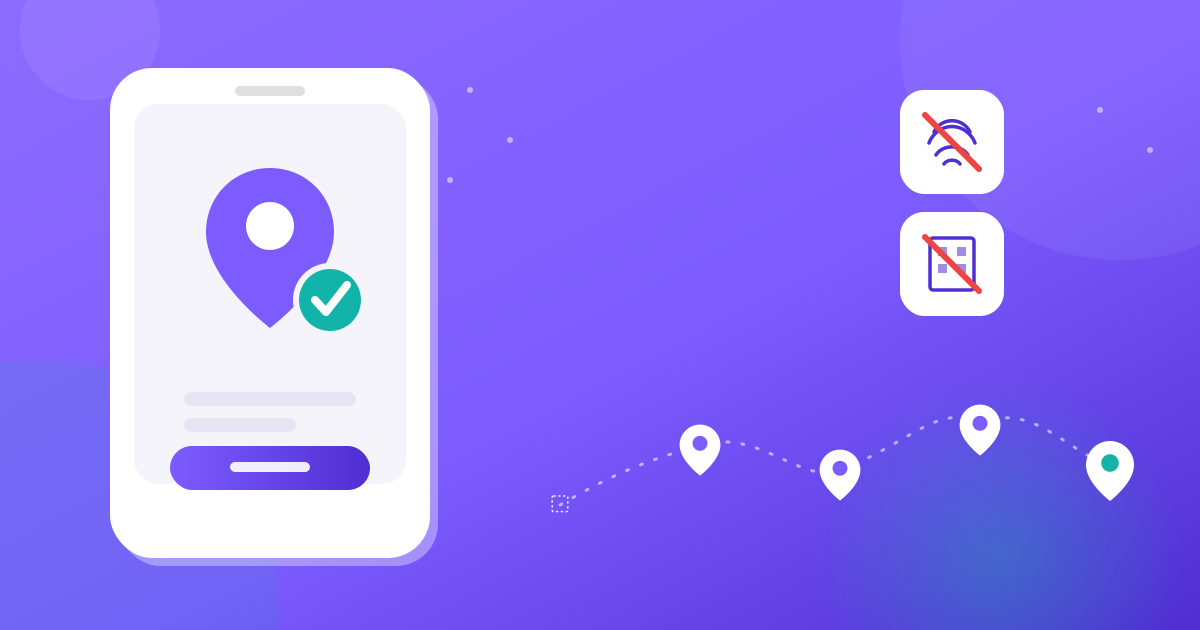
A traditional fingerprint device tells you when an employee showed up, but not where. This opens a well-known loophole in many companies: an attendance record gets logged for an employee who wasn't actually at the workplace, whether by mistake or by collusion. In companies operating across multiple branches or field locations, this loophole gets even bigger — how do you confirm that a branch-two employee's check-in actually happened at branch two?
The fix is tying every check-in and check-out to an actual GPS location that's automatically compared against approved work locations, so the direct manager knows where each punch was recorded, not just when.
3. Payroll and wage protection compliance are calculated manually from separate spreadsheets
In markets with strict wage protection requirements (such as Saudi Arabia's WPS), even a small error transferring attendance data into the payroll file can mean delayed salary payments or a compliance violation with labor authorities. When attendance data lives in one system and payroll data lives in a manually-filled spreadsheet, the chance of human error multiplies, and so does the time spent reconciling the two every month.
An integrated system connects actual attendance records directly to the calculated salary due, reducing errors and turning wage-protection file preparation into a matter of minutes instead of days.
4. Leave and permission requests go through WhatsApp or paper forms
When an employee sends a leave request to their manager over a WhatsApp message, or fills out a paper form, the company loses two important things: first, a documented record to refer back to in case of any dispute about when — or whether — approval actually happened; and second, an accurate leave balance that updates automatically. The usual result is small but recurring disputes between employee and management over "was this actually approved or not?", plus extra time spent manually tracking these requests.
Digitizing requests and approvals — from leave to permissions to attendance corrections — keeps a full record of every decision and updates balances automatically the moment approval happens.
5. You don't have real-time reports to help you make decisions
Many managers only discover declining punctuality, or rising absence rates in a particular team, after it's too late — sometimes months later, once the monthly report is finally ready. A late decision is just as costly as no decision at all: a missed opportunity to address a performance or discipline issue while it was still small.
Real-time reports that show the status of every team and every employee as it happens let a manager act in the first week a problem appears, not at the end of the month.
The bottom line: the real cost isn't the price tag — it's time and risk
A "cheap" attendance system that requires constant manual intervention, offers no reliable location data, doesn't integrate with payroll and wage protection, doesn't digitize requests, and gives you no real-time reporting is, in reality, the more expensive choice in the medium term — even if it looked like the cheapest option at purchase.
An app like WorkUp is designed to close all five of these gaps at once: fingerprint attendance tied to GPS location, automatic calculation of lateness and overtime, direct integration with payroll and wage-protection data, full digitization of leave/permission requests and approvals, and real-time reports for every team leader, right from their phone.
Frequently Asked Questions
Does a fingerprint attendance system automatically handle wage protection (WPS) calculations?
In integrated systems like WorkUp, yes — actual attendance data feeds directly into the calculated salary due, reducing manual errors when preparing the wage-protection file.
Can you see the actual GPS location where an employee checked in?
Yes. When location tracking is enabled, GPS coordinates are attached to every check-in and check-out, and the team leader or management can view them directly from the dashboard or the mobile app.
Is this type of system suitable for small and medium-sized businesses?
Yes — the five problems above aren't tied to company size, they're tied to how attendance is managed. Even a ten-person team benefits from digitized requests and real-time reporting just as much as a team of hundreds does.